Why Sex Scenes Fail (And How to Fix Them)
'His manhood throbbed with desire.' 'She surrendered to the waves of ecstasy.' 'Their bodies became one in a dance as old as time.' You've read these sentences, or ones like them, and you've winced. Not because the scene was explicit, but because it wasn't honest. The prose was performing rather than rendering. The metaphors were hiding from the body instead of inhabiting it. And the characters could have been anyone, anywhere, in any story.
Most failed sex scenes share this root cause: the writer didn't know what the scene was about. The emotional stakes, not the physical choreography. What does this character risk by being vulnerable? What does the other person learn by paying attention? Where is the power, and does it shift? Without answers to these questions, you're writing choreography.
If you can remove a sex scene and nothing changes (the characters are in the same emotional place, the relationship hasn't shifted, the plot hasn't moved), the scene shouldn't be there. Explicit content is not a substitute for narrative purpose.
The fix is to treat a sex scene like any other scene. It needs to reveal character. It needs to shift the dynamic between the people in the room. It needs to advance something. The writers who consistently produce effective sex scenes share one habit: they know the emotional stakes before they write a single physical detail.
The Four-Part Structure of a Sex Scene
Approach, escalation, internal climax, aftermath
Approach. Escalation. The scene's internal climax. Aftermath. These four phases structure every effective sex scene, and ignoring them is why so many read as either rushed or shapeless.
The approach is where emotional or physical distance begins to close: a look that holds too long, a hand that doesn't move away, the decision to step closer instead of stepping back. The escalation builds through contact, dialogue, or the removal of barriers. The scene's internal climax may or may not be literal. And the aftermath is where the characters process what just happened.
The aftermath is the most underwritten phase, and it's often the most important. What happens emotionally after physical vulnerability? Does a character retreat, soften, panic, feel exposed? Do they reach for humor to defuse the intensity, or sit in the silence? The aftermath reveals what the encounter actually meant.
This micro-arc within a scene mirrors the macro-arc of the story itself. Approach parallels awareness. Escalation mirrors the tension build. Climax reflects the story's crisis. Aftermath echoes resolution. When the internal shape of your sex scenes matches the larger structure, the story feels cohesive at every scale.
How Voice and POV Shape a Sex Scene
The same threshold in two registers
She unbuttoned his shirt. In Deep Slow Burn, those four words take a paragraph. Every button a decision, every inch of skin a revelation, her fingers trembling not from nervousness but from the weight of finally being allowed. In Confessional, it becomes one frantic sentence in a run-on paragraph of internal panic. In Romcom, she gets the third button stuck, they both laugh, and the laughter is what makes the moment real.
DEEP SLOW BURN: The third button. She stopped there, though not because she had lost her nerve. She had lost her nerve ten minutes ago and kept going anyway. Beneath the third button she could feel him breathing, and the rhythm was wrong. Too controlled. He was holding himself still the way you hold yourself still when any movement might break something, and she realized he was more afraid of this than she was. She undid the button slowly. He exhaled like he had been drowning. CONFESSIONAL: Third button and I'm thinking about my hands which is a terrible thing to be thinking about because my hands are shaking, obviously they're shaking, and he can absolutely feel that, and I should say something clever or at least something that isn't 'sorry my hands are doing this' but then his breath catches, actually catches, like something physical happened, and I forget about my hands entirely because that sound is the best thing I've ever heard and I want to hear it again.
In Dark Romance, the prose is controlled and power-aware: every movement deliberate, the reader feeling the weight of who's directing. In Literary, the prose reaches for imagery and metaphor that carries its weight, the physical rendered through the lens of the character's emotional landscape.
You don't need to use the same voice throughout an entire story. A first sex scene might use slow, lingering prose for maximum anticipation while a later scene goes raw and direct to reflect how the characters have changed. The voice should evolve with the relationship.

Calibrating Heat: The Explicitness Spectrum
Not every scene needs the same heat level, just as no story needs the same ceiling. Level 0 is pure emotional tension with no physical content. Level 5 is fully rendered, nothing withheld. The choice between them is creative, not moral, and it should change across the arc of your story.
At Level 1–2, scenes fade to black with a charged setup. The reader knows what's happening; the prose gives them the approach and the aftermath but closes the door on the middle. This works well when the decision to be intimate is more important than the act itself.
At Level 3–4, scenes are explicit but selective. The prose renders specific physical details while choosing which moments to linger on and which to compress. This range gives you the most control over pacing within the scene itself.
At Level 5, scenes are fully rendered. Nothing is compressed, and the prose commits to the physical experience completely. This level works when the scene's narrative purpose requires the reader to be entirely inside the experience, when the physical details themselves carry the character development.
Graduate the heat across your story's arc. Early chapters can operate at the low end (tension, proximity, the promise of more) while later chapters deliver at full intensity. The graduation itself becomes a pacing tool, and the reader feels the escalation as part of the story's shape.
Writing the Awkward Moment
Imperfection as a craft tool
Every sex scene you have seen in a movie is choreographed. Nobody bumps foreheads. Nobody says something stupid at the wrong moment. Nobody laughs at a sound that wasn't supposed to be funny. And that is exactly why most written sex scenes feel fake: the writer is directing a movie instead of inhabiting a room where two nervous, imperfect people are trying to figure out what they want and how to ask for it.
The awkward moment is a craft tool. A fumbled button breaks the performative tension and replaces it with something real: two people who are slightly bad at this, which means two people who are actually present. The nervous laugh that escapes at the wrong time and somehow makes everything more intense because the pretense is gone. The whispered 'wait, not like that' that could kill the mood but instead creates it, because now the characters are communicating instead of performing.
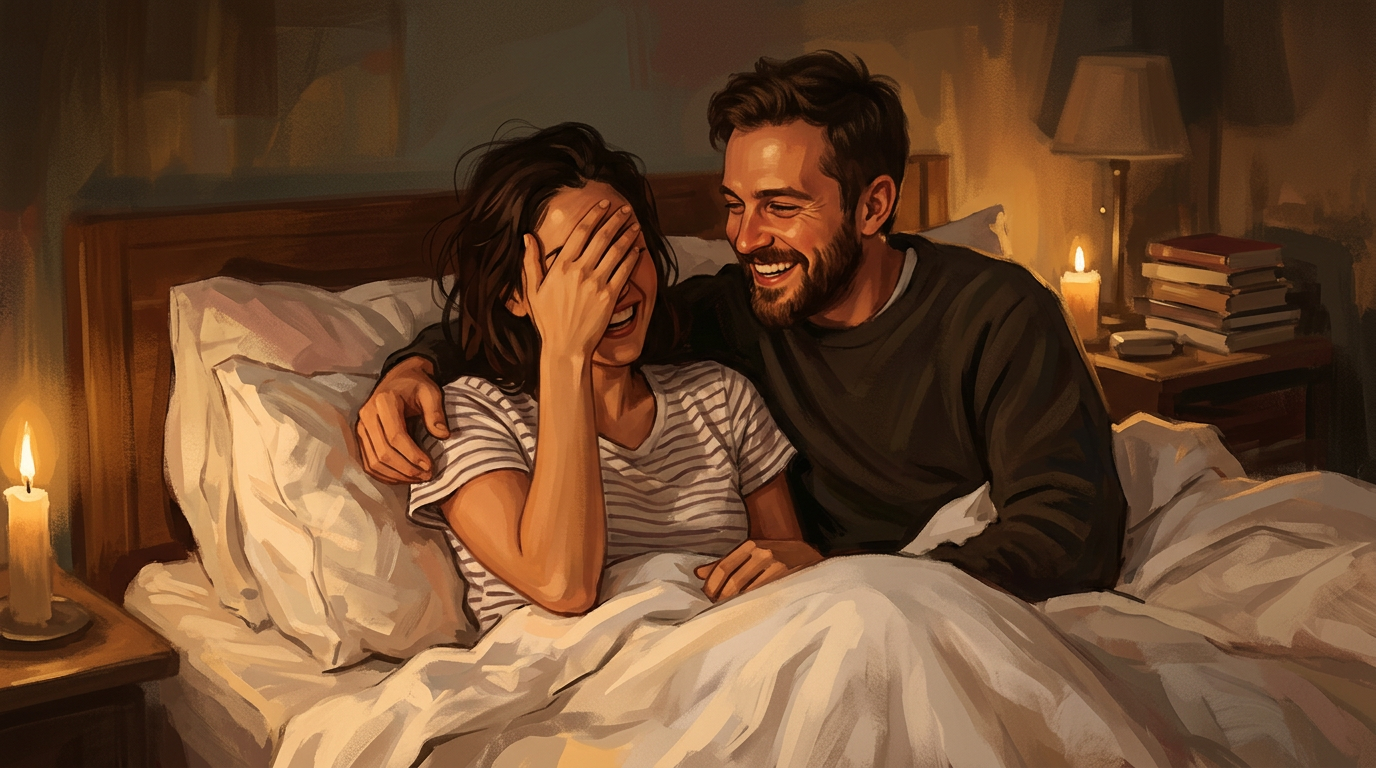
The zipper stuck. Of course the zipper stuck. She tugged at it with the same hand that was trying to maintain the illusion that she was someone who undressed gracefully, and his expression, which had been appropriately heated two seconds ago, shifted into something worse. He was trying not to smile. 'Don't,' she said. 'I wasn't going to say anything,' he said, and then he reached over and freed the zipper with one hand, which was annoying because it was also attractive, and she said 'I loosened it for you,' and he said 'Obviously,' and they were both laughing when he kissed her, and the laughter didn't stop the kiss. It lived inside it, and the whole thing was better than any version she had choreographed in her head.
Perfection is the enemy of intimacy. The fumbled button, the nervous laugh, the whispered 'wait' — these are the moments that make a sex scene feel real. Real people are imperfect and present, not choreographed and performing.
Sex Scenes in Serialized Fiction
The first intimate scene lands. The second one also lands, but with a faint sense of familiarity. By the third, the reader checks out because the writer is writing the same scene with different positions. This is the repetition problem, and it's the biggest craft challenge in serialized intimate fiction.
Each scene needs to feel different because the characters should be different. What changed between the last time and this time? Who has more power now? What is the emotional context: after a fight, after a confession, after a betrayal? The physical vocabulary should shift because the relationship has shifted.
The second challenge is maintaining tension after characters become physically intimate. In many stories, the sex scene is treated as the climax of the romantic arc, and everything after feels like denouement. In serialized fiction, the physical relationship needs to open new territory, not close the story's central question. What does intimacy reveal that attraction concealed? What new vulnerabilities emerge?
Characters should remember what happened. Callbacks to previous encounters: a touch that echoes an earlier one, a phrase that lands differently in a new context, a boundary that was once hard and is now soft. They give serialized fiction its cumulative power.
Sex Scenes in Practice
How established novels use intimate scenes to advance character
Diana Gabaldon's Outlander series is frequently studied for how its explicit scenes do character work no other scene could. Gabaldon uses first-person POV from Claire to keep the interiority continuous across the scene's four phases, and she uses aftermath dialogue (not the act itself) to mark the shifts in the relationship's power and trust.
Diana Gabaldon, Outlander series (1991–)
Sally Rooney's Normal People uses restrained, almost flat prose for its intimate scenes so the emotional content has to land in the dialogue and silence around them. The book is a useful counter-example to the assumption that explicitness equals impact: the heat comes from what the characters know about each other, not from the level of physical detail.
Sally Rooney, Normal People (2018)
Key Terms for Sex Scene Writing
Approach, escalation, aftermath, and the rest of the vocabulary
Sex scene craft vocabulary
- Approach
- The first phase of an intimate scene: emotional or physical distance begins to close. A look held a second too long, a hand that doesn't move away, the decision to step closer.
- Escalation
- The second phase: contact, dialogue, or removal of barriers raises the stakes. The reader should feel the temperature shift.
- Internal climax
- The scene's peak moment, which may or may not be a literal climax. In craft terms, it's the point of greatest vulnerability or revelation.
- Aftermath
- The fourth phase, most often underwritten: what happens emotionally after physical vulnerability. Where the scene's meaning is set.
- POV (point of view)
- First person puts the reader inside the body, so every sensation is immediate. Third person close maintains psychological access with slight observational distance.
- Heat level
- A 0–5 scale describing explicitness. The same scene can be rendered at any level by adjusting which beats are shown and which are implied.
- Awkward moment
- A craft technique: a fumbled button, a nervous laugh, a whispered "wait" that breaks the choreography and replaces performance with presence.
Fade to Black vs. Open Door Sex Scenes
When to show, when to imply, and how to choose
Fade to black and open door describe two opposite ways of rendering an intimate scene. Most contemporary romance lives somewhere on the spectrum between them, and many books use both at different points in the arc.
| Axis | Fade to Black | Open Door |
|---|---|---|
| What the prose shows | Approach, decision, aftermath. The physical scene itself is implied. | Approach, escalation, climax, aftermath, all rendered on the page. |
| When to choose it | When the decision to be intimate matters more than the act. | When the physical scene does character work no other scene can. |
| Pacing effect | Lets the scene act as a chapter pivot without slowing the arc. | Justified when explicit detail reveals a power shift or new vulnerability. |
| Typical heat levels | Levels 0–2 on the explicitness scale. | Levels 3–5. |
| Common in | Clean and sweet romance, some literary fiction. | Spicy romance, dark romance, erotica. |