Why Fantasy Romance and Romantasy Work
Personal desire intensified by epic stakes
The reader finishes a chapter at 2 AM. The kingdom is at war, two rival courts are on the edge of collapse, there is a prophecy that might kill the protagonist, and all they care about is whether the general is going to admit what happened in the training room. That's fantasy romance working at full power: a world so high-stakes that the personal desire becomes more intense, not less, because of everything surrounding it.
The genre, increasingly called romantasy, has become the dominant commercial force in publishing, and for good reason. It refuses to choose between epic stakes and personal desire. Sarah J. Maas, Rebecca Yarros, Jennifer L. Armentrout, and a wave of indie authors have proven that fantasy romance is no niche. It is a category that outsells most of what sits beside it.
What makes the genre distinct is that the fantasy elements are the mechanism of desire. The worldbuilding isn't backdrop. It is the engine that makes the romance feel inevitable.
Mating bonds create involuntary attraction that characters must negotiate. Rival courts force enemies into alliances that become something else. Magical power imbalances generate tension that's simultaneously political and personal. The craft challenge for writers isn't building the world OR writing the romance. It is making them inseparable. A fantasy romance where the reader has to get through the political intrigue to reach the kissing has missed the point.
Worldbuilding That Serves the Romance
Three paragraphs explaining the court's political structure. A magic system exposition dump right when the characters are about to touch. Detailed realm history delivered as dialogue no human would actually speak. These are the kills, the moments where fantasy romance loses the reader because the worldbuilding is competing with the romance instead of fueling it.
The fix is to reveal the world through the characters' emotional experience of it. The reader should understand court politics because they matter to the relationship: the rival faction is dangerous because they threaten someone the protagonist has come to need, not because the author needs the reader to understand the power structure. The magic system matters because it constrains what the characters can do about their feelings, not because it's intricate for its own sake.
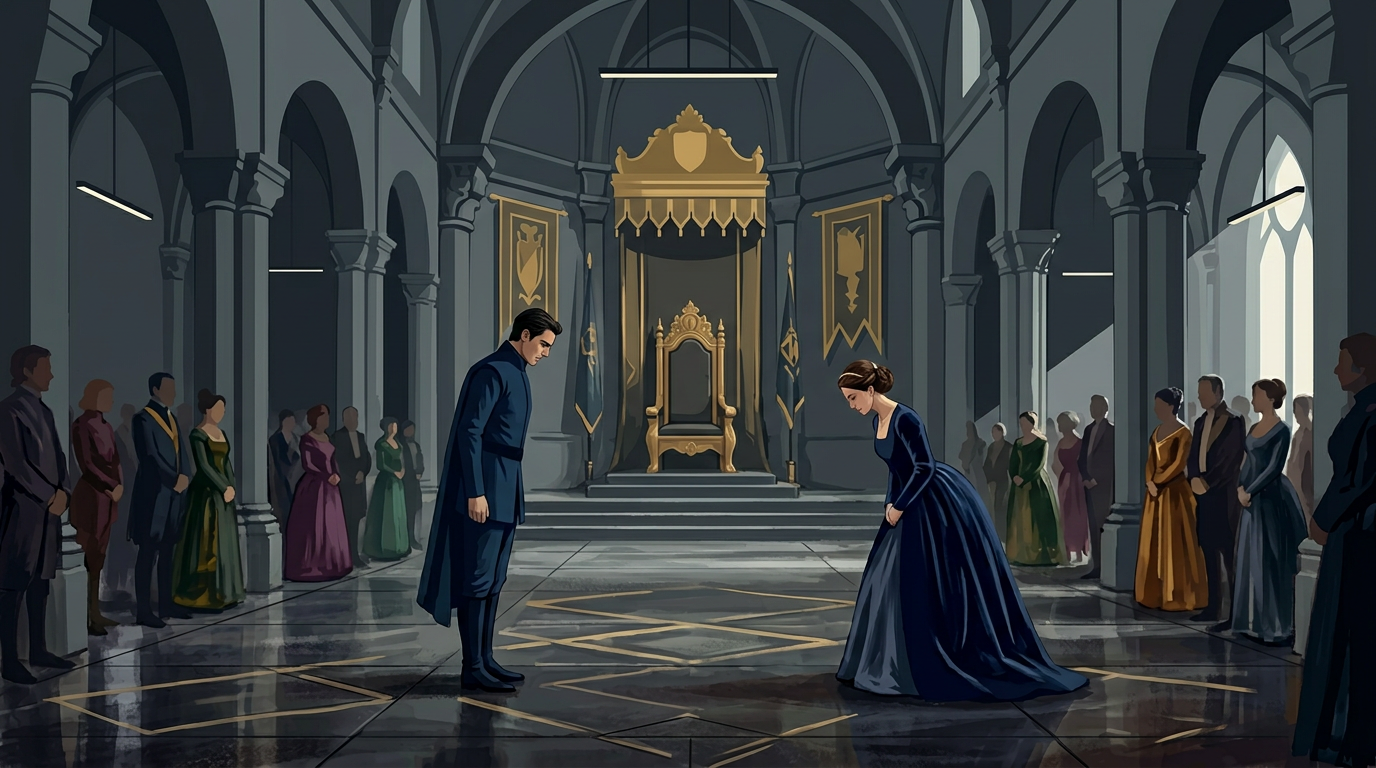
The throne room was designed to diminish. She knew that. The architect had written about it, the vaulted ceiling that made everyone beneath it feel the weight of the crown's authority. She'd read the plans. She understood the geometry. But understanding didn't stop the room from working on her when he was in it, standing beside the throne he hadn't wanted, wearing the expression he wore for court: the one that erased everything she had seen in private. The distance between them was thirty feet and a political system. She curtsied. He inclined his head. Neither of them looked at the other the way they had last night in the library, and the room full of advisors and courtiers had no idea they were watching two people pretend they hadn't already ruined everything.
Techniques that keep worldbuilding in service of the romance:
- Introduce world elements at the moment they create romantic tension: a law that forbids the relationship, a power that makes proximity dangerous, a custom that forces intimacy
- Filter world details through character interiority. The throne room matters because of who is standing in it, not because of its layout
- Use the world's constraints to generate the 'can't be together' pressure that romance requires. Obstacles rooted in the fantasy setting feel organic rather than manufactured
- Reveal history through personal stakes. The war matters because of what it did to this character, not because of troop movements
Magic Systems as Romantic Obstacles
No other romance subgenre can do this: create a romantic obstacle that's literally woven into the laws of the universe. A bond that makes two enemies feel each other's heartbeat. A prohibition built into the magic itself that makes touch between certain people lethal. A power that awakens only in the presence of the person you can't have. Fantasy romance turns worldbuilding into the 'can't be together' engine that all romance requires, and the obstacles feel inevitable rather than manufactured. They are the rules of the world, not the convenience of the plot.
A mating bond creates involuntary attraction that characters must negotiate on their own terms. The tension between what the bond demands and what the character freely chooses. A magical prohibition against relationships between certain groups creates forbidden desire with stakes that go beyond social disapproval. A power imbalance encoded in the magic system (one character who could destroy the other, one whose power awakens in the other's presence) generates tension that is simultaneously romantic, dangerous, and political.
Design your magical constraints to mirror your characters' internal conflicts. A character who fears losing control should exist in a magic system where power responds to desire. When the world's rules and the character's psychology push in the same direction, the romance and the fantasy become inseparable.
The craft move is structural: the magic system should make the romantic obstacle feel built into the universe rather than manufactured by the author. A character who refuses to trust should be bound to someone by a force that requires surrender. A character who fears vulnerability should discover that their power only works when they stop defending. The world's rules become the story's argument about what love costs.
Pacing Fantasy Romance Across a Long Arc
Keeping romance and plot escalating together
The romance fizzles in chapter seven while the plot takes over. Or the plot stalls in chapter nine because the romance is repeating the same tension without escalation. These are the two failure modes of serialized fantasy romance, and they happen because the writer is running two systems (romance and plot) in parallel without connecting them.
Structured pacing solves this. In a 12-part fantasy romance, a slow burn approach places the first four chapters in the awareness phase. Characters register each other's presence against the backdrop of the world's demands. Chapters five through eight enter resistance: the attraction is undeniable but the world's constraints prevent action. Chapters nine through eleven hit fracture — barriers crack under accumulated pressure. Chapter twelve delivers the surrender the entire arc has been building toward.
The pacing structure does not compete with the plot. It runs parallel to it. Awareness-phase chapters introduce the world. Resistance chapters drive political intrigue. The romance and the plot escalate together, or the story feels split.
The key is that each phase has room for the fantasy plot to advance simultaneously. Awareness chapters establish both the world's stakes and the romantic tension. Resistance chapters drive action and intrigue while characters navigate their growing inability to stay apart. The reader should never feel like the story is pausing one arc to service the other.
The Training Scene and the Battle Bond
Two romantasy set pieces every writer should master
Two set pieces define fantasy romance more than any others: the training scene and the battle bond. Both are romantic vehicles disguised as plot, and both work because they create the conditions (physical proximity, vulnerability, trust, danger) that make desire impossible to ignore.
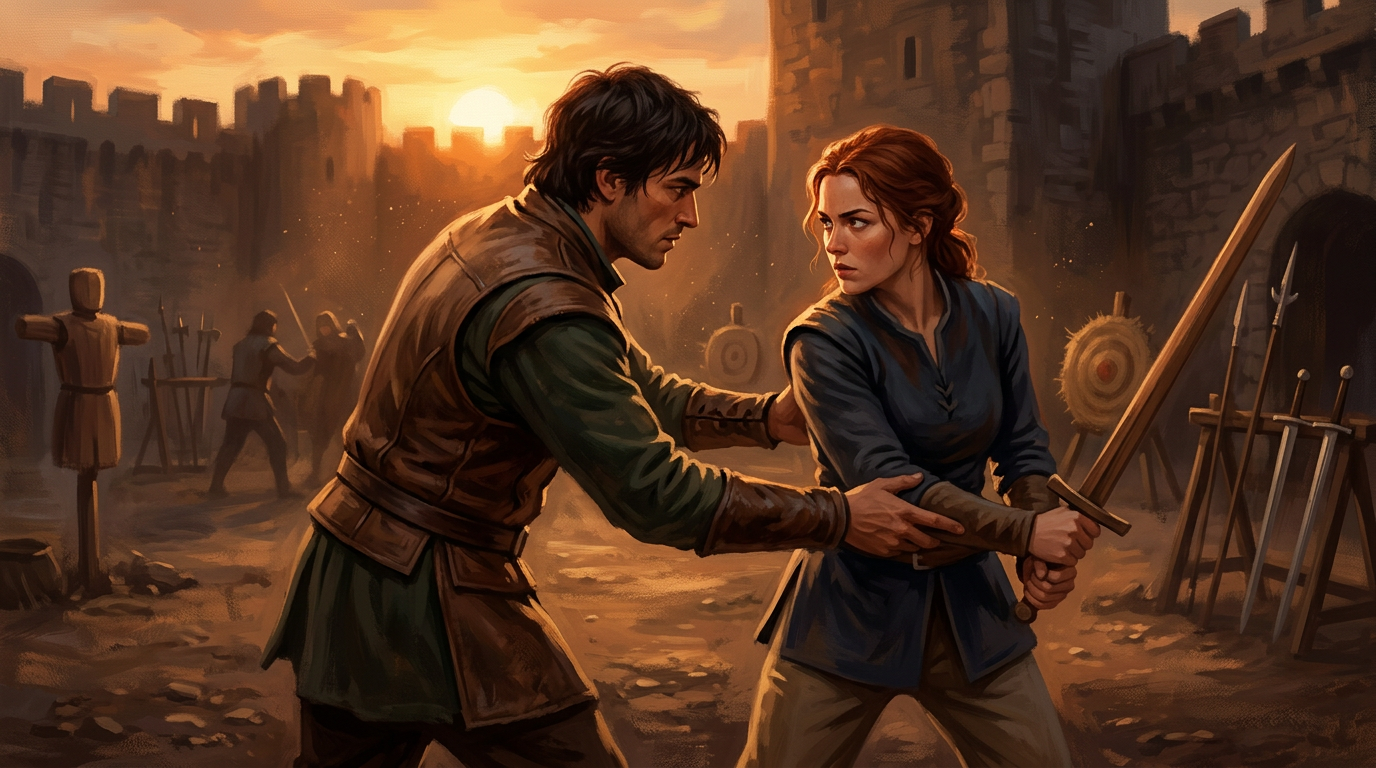
The training scene is forced proximity with a power dynamic built in. Someone is teaching. Someone is learning. There's physical contact that's technically instructional. There are corrections that require hands-on adjustment. Competence becomes attractive. Being pushed past your limits by someone means trusting them with your body. The training scene turns physical instruction into foreplay and the reader knows it even when the characters pretend they don't.
'Your stance is wrong.' He was behind her before she registered him moving, and his hand, warm and calloused and infuriating, pressed flat against her lower back. 'Here. You're compensating with your shoulders because your foundation is weak.' She bit back three responses, all of them inadvisable, and adjusted her footing. 'Better,' he said, and didn't move his hand. The practice yard was empty. The sun was low. She could feel his breath on the back of her neck and she was definitely not thinking about that. 'Again,' he said, and she swung the blade, and his hand stayed where it was like it had forgotten to leave, and she landed the strike perfectly because rage, it turned out, was excellent for focus.
The battle bond works the opposite direction. It forges intimacy through shared danger rather than shared instruction. Characters who've fought back-to-back, who've seen each other terrified and didn't run, who've been each other's survival have a kind of trust that no amount of court flirting can manufacture. The post-battle scene (adrenaline, relief, the desperate awareness that the other person is alive) is one of the most emotionally potent setups in all of romance.
The training scene is foreplay disguised as plot. The battle bond is intimacy earned through survival. Both create the conditions that make desire impossible to ignore.
Cast Complexity, POV, and Voice
Eight characters who need to feel like eight people
A fantasy romance cast is bigger than a contemporary romance cast, and that size creates specific craft problems. Love interests, rivals, allies, court factions, found families, antagonists with their own agendas. Eight characters who need to feel like eight people rather than eight functions. The difference is psychological specificity: backstory, internal conflicts around desire, and clear roles within the story that give each character a distinct internal logic the reader can track.
Point of view carries particular weight. First person, the approach popularized by Fourth Wing and A Court of Thorns and Roses, creates maximum intimacy with the protagonist's experience of both the world and the love interest. The reader sees the magic through one character's wonder, fear, or ambition. The love interest remains partially opaque, which preserves mystery.
Third person close offers more flexibility for complex plotting. You can shift between POV characters across chapters, giving the reader access to both sides of the romantic tension and to plot threads the protagonist can't see. The trade-off is slightly less immediate intimacy, but the structural advantages for political intrigue, multiple factions, and ensemble casts often make it the stronger choice.
Whichever POV you choose, dial in the exact prose register for your world. Literary style for high fantasy with weight and atmosphere. Cinematic for action-forward romantasy with visual pacing. Slow and aching for the quiet moments between battles. The voice should feel like it belongs to the world you've built.
Fantasy Romance in Practice
How current romantasy uses worldbuilding as the can't-be-together engine
Sarah J. Maas's A Court of Mist and Fury, the second book in her A Court of Thorns and Roses series, is often cited as the structural template for modern romantasy. Maas uses the mating bond as a question rather than a guarantee, lets court politics generate most of the can't-be-together pressure, and gives the training scenes between Feyre and Rhysand the structural weight of the romance's early-middle act.
Sarah J. Maas, A Court of Mist and Fury (2016)
Rebecca Yarros's Fourth Wing uses an enemies-to-lovers setup inside a war college, with battle bonds, training scenes, and forced proximity in a single dragon-rider quadrant. The book's commercial success is a useful data point for what the current romantasy reader expects: high stakes, fast cadence, banter that performs hostility while leaking attraction, and explicit scenes integrated into the arc rather than sequestered from it.
Rebecca Yarros, Fourth Wing (2023)
Key Terms in Fantasy Romance and Romantasy
Mating bonds, fated mates, training scenes, and the rest
Fantasy romance and romantasy vocabulary
- Romantasy
- Reader-driven shorthand for fantasy romance with roughly equal weight on worldbuilding and the love story. Coined and popularized in the early 2020s.
- Mating bond
- A magical or biological tie between two characters that creates involuntary attraction. The best mating bond stories use the bond as a question, not a shortcut.
- Fated mates
- Adjacent to mating bonds. The cosmic or prophetic version: these two were always meant to find each other. Common in shifter, fae, and dragon romance.
- Training scene
- A combat or magic-instruction scene that doubles as forced proximity with built-in power dynamics. Physical correction becomes the foreplay engine.
- Battle bond
- Intimacy forged through shared survival. Post-battle scenes (adrenaline, relief, the awareness that the other person lived) are some of the genre's most charged.
- Court intrigue
- Political maneuvering in a royal or noble setting. In romantasy, court intrigue is the can't-be-together engine: rival factions, betrothals, treaties.
- Prophecy and chosen one
- A foretold destiny that places the protagonist (and often the love interest) at the center of the world's stakes. Best when the prophecy raises the cost of the relationship rather than guaranteeing it.
Fantasy Romance Compared with Romantasy and Paranormal Romance
Different shelves, overlapping engines
Fantasy romance, romantasy, and paranormal romance get used interchangeably. They aren't the same shelf, but the overlap is real.
| Axis | Fantasy Romance / Romantasy | Paranormal Romance |
|---|---|---|
| Setting | Secondary world: invented courts, magic systems, geography. | Real-world contemporary or historical, with supernatural elements layered in. |
| Common creatures | Fae, dragons, gods, magic-users, original species. | Vampires, werewolves, witches, ghosts, demons. |
| Romance weight | Romantasy gives romance equal weight; fantasy romance can lean either way. | Romance is primary; paranormal element supplies the obstacle or species conflict. |
| Series length | Long arcs (4–7+ books) are common. | Often longer-running with rotating couples (PNR series). |
| Pacing of the romance | Slow-burn arcs across multiple books are typical. | Often single-book HEA per couple, then new couple next book. |